May 2026 Fuel Prices: Global Forecast and Market Analysis
May 2026 fuel prices are currently at the center of a global economic debate, as consumers and policymakers navigate a landscape of unprecedented volatility. The question of whether energy costs will increase or decrease in May 2026 is one that weighs heavily on the minds of families and businesses worldwide. Fuel remains the lifeblood of modern economies, powering everything from daily commutes and global supply chains to manufacturing and agriculture. Its price volatility can ripple through virtually every sector, impacting inflation, disposable income, and corporate profits. For more localized market data, you can check our daily gold price updates

The Science of Energy Market Volatility – May 2026 Fuel prices
Fuel prices are notoriously volatile, subject to rapid and often unpredictable changes. This inherent instability stems from the myriad of global forces that influence the cost of crude oil, refining capacity, and distribution logistics. A minor disruption in one part of the world can send shockwaves across the entire market, leading to significant price adjustments at the pump.
As of late April 2026, the market is operating under a high-stress environment. According to the International Energy Agency (IEA), the de facto closure of the Strait of Hormuz since March has created unprecedented uncertainty. This waterway handles nearly 20% of global oil supply, and its disruption has added a significant “risk premium” to Brent crude, which is currently averaging around $96 per barrel.
Historical Context: How 2026 Compares to Previous Years
To understand the May 2026 fuel prices, we must look back at the trends of the last decade. In 2022, we saw historic highs due to the Ukraine conflict, with prices in some regions exceeding $120 per barrel. By 2024, prices stabilized in the $70–$80 range as production from non-OPEC countries, like the US and Brazil, hit record levels.
However, 2026 has introduced a “new normal.” The transition toward renewable energy is in full swing, yet the world’s immediate dependence on fossil fuels remains high. This creates a “supply squeeze” where investment in new oil fields has slowed down, but demand remains robust. This structural imbalance is a primary reason why we are seeing such high volatility this quarter.
Core Drivers of the 2026 Oil Economy
To forecast the direction of the market, we must dissect the fundamental drivers. Each factor contributes to the overall market sentiment and dictates the trajectory of energy costs.
1. Global Supply and OPEC+ Decision Cycles
The equilibrium between global crude oil supply and demand is the most significant determinant. On April 5, 2026, OPEC+ members—including Saudi Arabia, Russia, and the UAE—met to review market conditions. They decided to implement a production adjustment of 206,000 barrels per day starting in May 2026.
While this sounds like a lot, it is a relatively small increase compared to global consumption, which is nearing 103 million barrels per day. The decision highlights a cautious approach: OPEC+ wants to maintain a price floor of $85 per barrel to fund their national diversification projects, such as Saudi Arabia’s “Vision 2030.”
2. Geopolitical Stability and Strategic Chokepoints – May 2026 Fuel prices
The ongoing maritime conflict in the Middle East has moved from a regional issue to a global commodity shock. When shipping lanes are blocked, insurance premiums for oil tankers skyrocket. These “hidden costs” are eventually passed down to you at the petrol pump.
The World Bank reported in April 2026 that if the Strait of Hormuz remains restricted through May, oil prices could peak at $115 per barrel in the second quarter. This is not just a supply issue; it is a logistics issue. Even if oil is available, getting it to refineries in Europe and Asia has become a high-risk endeavor.
3. The Strength of the US Dollar
As an accountant, you know that crude oil is primarily traded in US dollars. The Federal Reserve’s decision in April 2026 to hold interest rates steady at 3.5% has kept the dollar strong. A strong dollar makes oil more expensive for countries using other currencies (like India or the EU), which can naturally lower demand over time. This “currency effect” is often the only thing preventing prices from spiraling even higher.
Predictive Scenarios for the Upcoming Quarter
Given the multitude of variables, we can outline three plausible scenarios based on current trends:
Scenario A: The “High Plateau” (Most Likely)
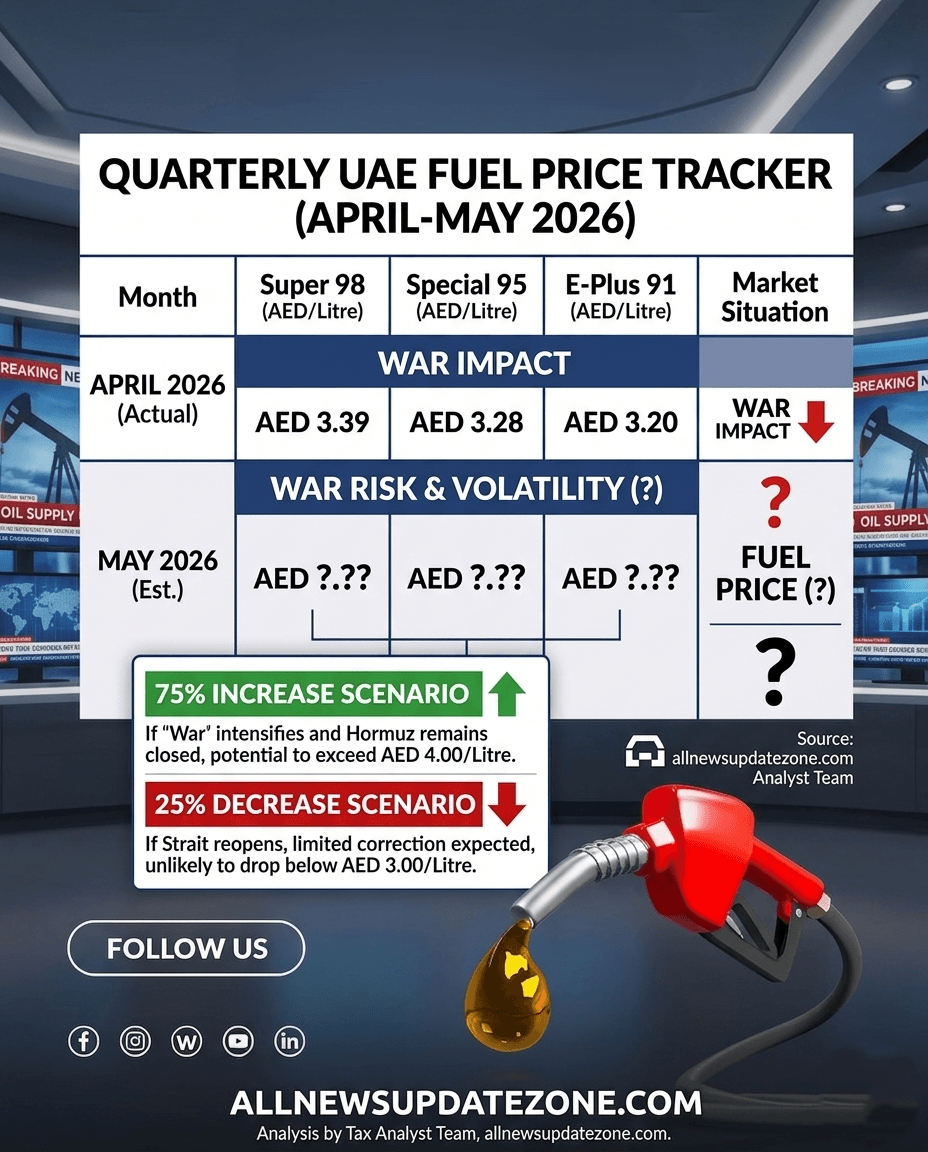
In this scenario, prices remain stable or see a very minor decrease. The OPEC+ production increase is offset by the risk premiums from the shipping blockades.
Scenario B: The “Supply Glut” (Optimistic)
If a diplomatic solution reopens major shipping routes by mid-May, the market would suddenly find itself oversupplied. This could trigger a rapid 15-20% drop in retail fuel prices within 14 days, bringing Super 98 back down toward the AED 2.80 range.
Scenario C: The “Escalation Spike” (Pessimistic)
Any direct damage to energy infrastructure in the Gulf—such as pipelines or processing plants—could push Brent crude toward $120. In this case, we would see fuel prices rise toward AED 4.00 per liter, a level not seen since the height of the 2022 energy crisis.
Regional Analysis: Impact on the UAE and India
The UAE Market
The UAE’s Fuel Price Committee has been proactive in adjusting rates monthly to reflect global trends. In April 2026, we saw a jump to AED 3.39 for Super 98. For May, the committee will be looking at the average Brent price from April 1st to April 25th. Since the average was roughly $94, May prices are likely to stay within 5 fils of April’s rates, unless a major event occurs this week.
The Indian Market
India, which imports over 80% of its oil, is particularly vulnerable. The Indian government has been utilizing strategic reserves to keep retail prices from exploding. However, if global prices stay above $95 throughout May, we can expect a gradual increase in petrol and diesel prices across major cities like Mumbai and Delhi.
Impact on Global Logistics and Supply Chains – May 2026 Fuel prices
Businesses in the transportation and manufacturing sectors are the hardest hit by fuel volatility. When diesel prices rise, the cost of moving goods increases. This leads to “Cost-Push Inflation,” where the price of your groceries and electronics rises because it cost more to ship them.
For digital publishers and content creators, this is a crucial topic. Understanding the macroeconomic impact of fuel (Outbound Link) allows businesses to better budget for their operational costs.
Strategies to Mitigate May 2026 Fuel prices Shocks
Both consumers and businesses must be proactive. Here is how to protect your finances:
Improve Vehicle Efficiency: Regular maintenance and avoiding “idling” can save a household up to AED 500 per year in fuel costs.
Route Optimization for Businesses: Use AI software to ensure delivery trucks are taking the shortest, most fuel-efficient paths.
Hedging for Corporations: Large companies can “lock in” fuel prices through financial contracts, ensuring their costs stay predictable even if the market spikes.
The Shift to EVs: 2026 is seeing a record number of residents switching to electric vehicles. With petrol near AED 3.40, the “break-even” point for an EV purchase is now just 3 years.
Frequently Asked Questions (FAQ)
Q1: Why do fuel prices change on the 1st of every month? Most regions, including the UAE, use a monthly pricing mechanism based on the average price of refined products in the international market from the previous month.
Q2: Will the UAE’s exit from OPEC impact May 2026 prices? While the UAE is seeking more production autonomy, any major shifts in production will take months to implement. Therefore, the impact on May’s retail prices will be minimal.
Q3: Is diesel more affected than petrol in 2026? Yes. Due to high demand in industrial manufacturing and shipping, diesel prices have remained consistently higher than Super 98 throughout early 2026.
Conclusion: Navigating the Future of May 2026 Fuel prices
The prediction for May 2026 fuel prices remains a complex equation. While the long-term trend leans toward a gradual reduction in fossil fuel dependence, short-term shocks remain a significant possibility. The interplay of OPEC+ production boosts, geopolitical stability, and the global shift toward electric mobility will shape the market.
As we approach the end of the quarter, continuous monitoring of GDP growth and maritime security will be essential for refining any predictions. Both consumers and businesses must remain adaptable, focusing on efficiency and strategic planning to navigate this era of energy uncertainty.