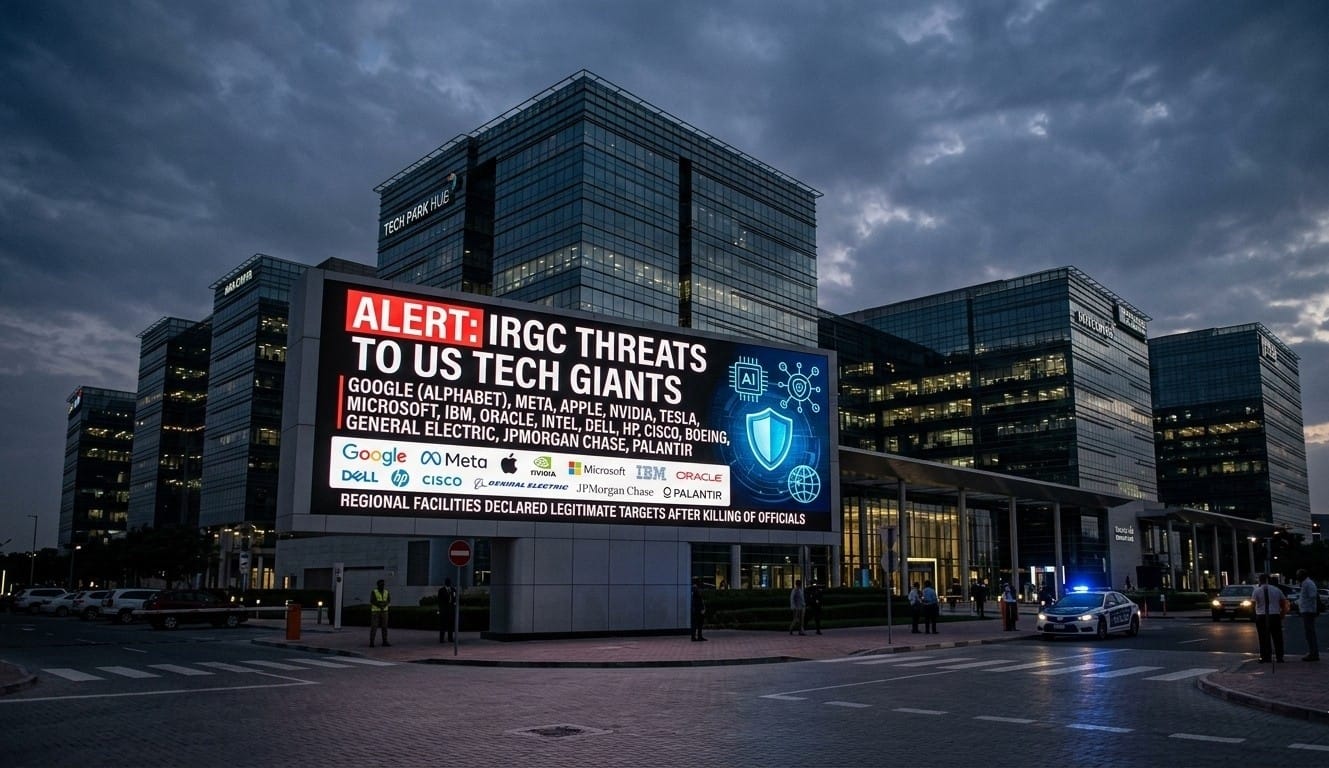
IRGC threats US tech giants have fundamentally changed the global security landscape this week. On Tuesday, March 31, 2026, the Iranian Revolutionary Guard Corps issued a direct warning to 18 major American corporations. These companies include household names like Google, Meta, Apple, and Nvidia. The IRGC now officially classifies these civilian businesses as “legitimate military targets.” Consequently, this declaration marks a terrifying evolution in modern conflict. The line between international commerce and state-sponsored warfare has completely vanished.
The IRGC alleges that these Silicon Valley giants are no longer mere providers of digital services. Instead, Tehran claims they are active participants in a military “kill chain.” By providing Artificial Intelligence (AI) and geospatial tracking data, these companies assist Western intelligence agencies. Furthermore, the IRGC holds these firms responsible for recent precision strikes against Iranian leadership.

Understanding the IRGC Threats US Tech Giants Deadline
To understand why these IRGC threats US tech giants are causing such panic, we must look at the specific deadline. The Guard Corps set a strict cutoff of 8:00 PM Tehran time on Wednesday, April 1, 2026. According to the official statement, any regional facility belonging to these 18 firms is now considered a combat zone. Furthermore, the IRGC warned all employees to evacuate these offices immediately.
This has sparked a wave of anxiety across major Middle Eastern business hubs. Cities like Dubai and Doha host a massive physical footprint for many of these corporations. Therefore, the threat is not just a digital concern; it is a physical reality. Many workers are now questioning the safety of their office buildings and tech parks.
The 18 Companies Targeted by Iran
The “hit list” associated with these IRGC threats US tech giants includes the backbone of the American economy.
Computing & AI: Google (Alphabet), Microsoft, Nvidia, and Oracle.
Hardware & Mobile: Apple, Intel, Dell Technologies, HP, and Cisco.
Social Media & Analytics: Meta (Facebook/Instagram), IBM, and Palantir.
Aerospace & Industry: Boeing, General Electric, and Tesla.
Finance: JPMorgan Chase.
Why IRGC Threats US Tech Giants Focus on AI Warfare
The core grievance behind the IRGC threats US tech giants is the “weaponization” of the cloud. In the past, nations fought wars with steel and gunpowder. However, today they fight with algorithms and data. Tehran argues that Nvidia’s high-performance chips are essentially military tools. Additionally, they claim Google’s geospatial data allows for “signature strikes” against their officials.
The Role of Precision Targeting and Data
Military analysts suggest these threats are a response to recent drone operations. Artificial Intelligence analyzes massive amounts of data to find high-value targets. This includes social media movement, facial recognition, and cell phone pings. The IRGC insists that these precision assassinations require corporate cooperation. Consequently, they now view tech CEOs as military commanders rather than business leaders.
Furthermore, the IRGC claims that Meta and Apple harvest user metadata for espionage. They believe this data goes directly into U.S. and Israeli intelligence databases. This narrative frames every smartphone as a potential tool of war. Therefore, the IRGC is attempting to create a climate of fear around Western device ownership in the region.
Regional Security Impact of IRGC Threats US Tech Giants
The most immediate danger of these IRGC threats US tech giants is felt in the United Arab Emirates. For years, the UAE has been a global technology sanctuary. Hubs like Dubai Internet City host thousands of Western employees. However, the IRGC told civilians to stay at least one kilometer away from these buildings.
Evacuation Warnings and Local Business Panic
This warning has led to significant logistical nightmares for local businesses. While local security forces have increased patrols, the psychological impact remains high. Many multinational firms are currently debating a move to 100% remote work. Additionally, others are considering relocating staff to safer territories in Europe or Asia. This uncertainty threatens the economic stability of the entire region.
Furthermore, the threat of “destructive actions” could take several forms. Experts suggest that kinetic drone strikes are a distinct possibility. Alternatively, the IRGC might use “wiper” malware to delete regional customer data. Consequently, this would cause a massive disruption in digital services for millions of people.
Global Economy and IRGC Threats US Tech Giants
As news of the IRGC threats US tech giants broke, the NASDAQ saw immediate downward pressure. Investors are terrified of this new precedent. If a state actor targets a civilian corporation, the “risk premium” for tech stocks will naturally rise.
Tech Stocks and the Economic Fallout
Shares of Nvidia and Microsoft dipped as the April 1 deadline approached. Financial analysts warn that a strike on a data center could cause a “cascading failure” in global services. This would affect banking apps, hospital systems, and global logistics. Therefore, the global economy could lose billions of dollars in a single day of conflict.
Furthermore, commodities are reacting to this regional instability. Crude oil prices jumped by $3 a barrel within hours of the IRGC announcement. Similarly, you can see a surge in prices on our [Live Gold Rate] page. Gold is a classic “safe-haven” asset during times of war. The threat to Tesla and General Electric also suggests a hit to the global energy transition. You should also check our latest [UAE Fuel Prices] to see how this affects your local costs.
Conclusion: A New Era for Global Technology
In conclusion, the IRGC threats US tech giants represent a “new normal” in 2026. We are moving toward a divided, or “Balkanized,” internet. Different regions may soon use entirely different hardware to avoid being caught in the crossfire. However, this shift will likely slow down global innovation for years to come.
The relationship between Silicon Valley and the Middle East has changed forever. Tech companies can no longer claim they are neutral actors in global politics. They must now protect their physical assets and staff from state-sponsored military action. All News Update Zone